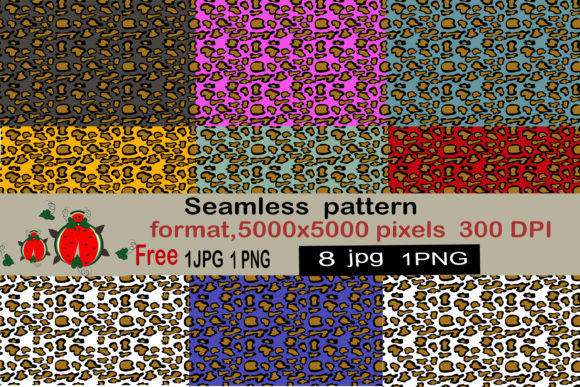
Leopard Digital Paper Seamless Pattern: A Strategic Creative Asset for Modern Design Workflows
In today’s fast-paced creative economy, professionals—from freelance designers and print-on-demand entrepreneurs to marketing teams and boutique product developers—are rethinking how they source, scale, and deploy visual assets. At the intersection of aesthetics, functionality, and efficiency lies the Leopard Digital Paper Seamless Pattern: a high-resolution, production-ready digital pattern designed not just to look striking, but to integrate seamlessly across physical and digital touchpoints.
What Is the Leopard Digital Paper Seamless Pattern—Really?
The Leopard Digital Paper Seamless Pattern is more than a decorative motif—it’s a precision-engineered digital asset built for versatility and fidelity. Unlike low-res or tiled web graphics, this pattern is delivered at 5000 × 5000 pixels, 300 dpi, ensuring crisp reproduction whether printed on luxury stationery or scaled across a 12-foot retail backdrop. Its seamless construction means no visible repeats or alignment artifacts—critical for fabric sublimation, garment printing, and large-format applications where continuity defines quality.
It comes in two practical formats: one transparent PNG (watermelon format) ideal for layering over branding elements or digital mockups, and eight high-fidelity JPG variants (also watermelon format), each optimized for different color profiles and output environments. This dual-format strategy reflects an industry-wide shift toward “asset-first” design—where creators prioritize adaptable, context-aware files over one-off visuals.
Why It Fits—and Fuels—Contemporary Creative Trends
Three converging trends make the Leopard Digital Paper Seamless Pattern especially timely:
- Rise of hybrid physical-digital product ecosystems: From limited-edition apparel drops promoted via Instagram Reels to custom-printed party supplies sold through Shopify stores, creators now operate across tactile and screen-based channels simultaneously. A single pattern that performs equally well on cotton twill, matte business cards, and iPad lock screens reduces workflow fragmentation—and eliminates costly reformatting.
- Democratization of premium print capabilities: Sublimation printers, DTG (direct-to-garment) machines, and desktop cutters are no longer exclusive to industrial studios. With entry-level equipment now delivering near-commercial quality, professionals need assets engineered for those tools—not legacy offset standards. The 300 dpi resolution and CMYK-friendly color depth of this leopard pattern meet that demand without requiring expert retouching.
- Consumer expectation of intentional design coherence: Today’s audiences recognize—and reward—brand consistency. A customer who receives a leopard-patterned invitation, then sees the same motif on a branded tote bag or Zoom virtual background, experiences narrative continuity. That cohesion isn’t accidental; it’s enabled by scalable, modular assets like the Leopard Digital Paper Seamless Pattern.
Practical Integration Across Real-World Use Cases
Professionals aren’t adopting this pattern because it’s trendy—they’re using it because it solves concrete problems. Here’s how:
Fabric & Apparel Development
For fashion designers prototyping capsule collections, the pattern’s seamless tile allows infinite repeat testing on digital fabric simulators before committing to yardage. When paired with polyester sublimation, the high-resolution JPGs translate precisely to vibrant, edge-to-edge prints on activewear or scarves—no pixelation, no seam lines.
Brand Extension & Merchandising
Marketing teams launching seasonal campaigns use the pattern as a unifying visual thread: applied to email headers, downloadable checklists, event banners, and physical swag. One designer reported cutting production time by 40% when rolling out a summer campaign—because the same file served web, print, and social video overlays without reworking.
Small-Batch Product Creation
Entrepreneurs selling handmade goods on Etsy or Amazon Handmade leverage the PNG version to create photorealistic mockups. Layered over editable templates, it conveys texture and scale far more convincingly than generic stock patterns—boosting perceived value and conversion rates.
Digital Experience Design
UI/UX designers incorporate subtle leopard motifs into dashboard backgrounds or app loading screens—not as literal animal prints, but as rhythmic, organic textures that add visual interest without competing with interface elements. The watermelon format ensures transparency works natively with Figma, Adobe XD, and Webflow.
Shifting Expectations: Why “Good Enough” Isn’t Enough Anymore
A decade ago, many creatives accepted compromises: low-res downloads for web use, separate files for print, manual tiling for fabric repeats. Today, those trade-offs erode credibility and slow iteration. Clients expect polished deliverables across platforms—and tools like Canva, Printful, and Adobe Express make cross-platform publishing easier than ever. What’s changed isn’t just capability, but expectation.
The Leopard Digital Paper Seamless Pattern answers that shift by being production-native. It assumes you’ll use it for screen printing on denim jackets and also as a subtle animated wallpaper on a MacBook. It assumes you may need to extract a single motif for embroidery digitizing—or zoom into a 200×200 px section for a favicon variant. Its design anticipates downstream flexibility, not just upstream aesthetics.
Technical Rigor Meets Creative Intuition
This isn’t about arbitrary resolution numbers. At 5000 × 5000 pixels and 300 dpi, the pattern delivers true scalability: it can be reduced to 10% size for a watermark and still retain clarity, or enlarged to cover a 40-inch wide banner without interpolation artifacts. The watermelon format—while sounding playful—is a signal of technical intentionality: it refers to standardized, pre-optimized color handling that minimizes banding and ensures consistent rendering across devices and software.
Moreover, the leopard motif itself bridges timeless appeal with contemporary reinterpretation. It avoids cliché through balanced negative space, nuanced tonal variation, and a slightly softened edge treatment—making it appropriate for luxury skincare packaging as easily as for gender-neutral children’s party supplies.
Looking Ahead: Patterns as Infrastructure
As generative AI accelerates asset creation, the value of human-crafted, purpose-built patterns is increasing—not decreasing. Algorithms generate novelty; professionals curate reliability. The Leopard Digital Paper Seamless Pattern exemplifies what’s next: digital assets treated as infrastructure—tested, documented, interoperable, and embedded in workflows rather than bolted on after the fact.
That’s why forward-looking studios include such patterns in their brand kits alongside fonts and color palettes. Why agencies license them for client projects with clear usage rights. Why educators teach students to evaluate patterns not just by appearance, but by metadata, scalability, and export readiness.
Final Thought: Design Is Workflow, Not Just Output
Choosing the Leopard Digital Paper Seamless Pattern isn’t about selecting a visual style—it’s about optimizing how you work. It reflects an understanding that creativity thrives when friction is removed: between idea and execution, between digital and physical, between concept and commerce. In an era where speed, consistency, and adaptability define competitive advantage, this pattern doesn’t just decorate—it enables.
If you're building products, shaping brands, or scaling creative services, consider how much time, budget, and cognitive load you currently spend adapting visuals across contexts. Then ask: what could you do with those resources—reallocated, refocused, and reinvested—when your foundational assets already speak the language of every medium you serve?