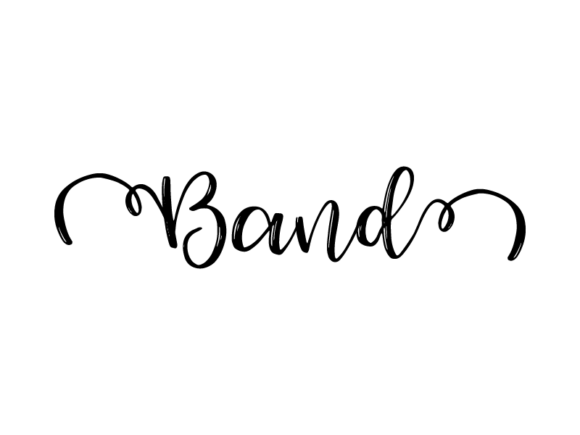
Band Lettering & Hand-Drawn Vector Monochrome Graphics: Your Versatile Creative Toolkit
Imagine a single design file that transforms your t-shirt into a statement piece, turns a classroom poster into an inspirational centerpiece, and elevates your small business branding with authentic, human-made charm—all while remaining fully editable in seconds. That’s the power of band lettering and hand-drawn vector monochrome graphic lettering. More than just decorative fonts or static images, this category represents a thoughtful fusion of artisanal expression and digital flexibility—designed for creators, educators, entrepreneurs, and hobbyists who value both personality and precision.
What Exactly Is Band Lettering?
Band lettering refers to stylized, often rhythmic, hand-crafted typography inspired by music posters, vintage concert flyers, and underground zine culture. Unlike traditional typefaces, band lettering emphasizes irregular baselines, expressive weight shifts, intentional imperfections (like slight wobbles or tapered strokes), and organic spacing—evoking energy, rebellion, or nostalgic warmth. When digitized as vector-based monochrome graphics, these letterforms retain their handmade soul while gaining infinite scalability and adaptability.
Crucially, “monochrome” here doesn’t mean dull—it means intentionally limited to one color (typically black or white), which ensures crisp reproduction across any medium: screen-printed on fabric, laser-cut from vinyl, embossed on paper, or printed on ceramic mugs. And because it’s built in vector format (SVG, EPS, or AI), every curve, serif, and flourish remains mathematically precise—no pixelation, no quality loss, no matter how large you scale it.
Why This Design Style Matters Today
In an age saturated with AI-generated content and cookie-cutter templates, authenticity resonates. Consumers—and students, colleagues, and collaborators—increasingly respond to work that feels human-made. Band lettering delivers that tactile credibility without sacrificing modern utility. It bridges two vital needs:
- Creative identity: A hand-drawn “Dream Big” banner on your classroom wall communicates care and intention far more than generic clipart.
- Production efficiency: That same banner can be resized for a 4×6” business card or a 6-foot event backdrop—without reworking a single line.
This duality makes band lettering especially valuable for small businesses launching merchandise, teachers building inclusive learning environments, makers running Etsy shops, and designers crafting cohesive brand systems—all without needing advanced illustration skills.
Real-World Applications You Can Start Using Today
Because these files are delivered as editable vectors, they integrate seamlessly into everyday creative workflows. Here’s how they’re actively used across industries:
- Apparel & Textiles: Print “Stay Wild” lettering onto organic cotton tees, embroider “Create Daily” onto tote bags, or heat-transfer “Rise Up” onto sportswear—each time preserving the original stroke integrity.
- Educational Tools: Teachers use cut files to create tactile alphabet cards for early learners, motivational quote posters for behavior charts, or custom name tags for collaborative stations—all easily recolored to match classroom themes.
- Marketing & Branding: A café might use monochrome band lettering for its logo lockup, then reuse the same vector file across Instagram story banners, loyalty program stickers, and takeout cup sleeves—ensuring visual consistency at zero extra design cost.
- Home & Lifestyle Products: From minimalist pillow embroidery (“Breathe”) to engraved wooden coasters (“Good Vibes Only”), the clean lines translate beautifully to laser cutting, sublimation, and foil stamping.
- Digital & Print Media: Use the SVG directly in Figma for UI mockups, embed it in email newsletters via inline SVG, or place it into InDesign layouts for magazines and e-books—always retaining editability and sharpness.
How Editing Works (Even If You’re New to Design)
You don’t need to be a graphic designer to use these files—but understanding the basics helps you unlock their full potential. Since they’re vector-based, not raster (like JPEGs or PNGs), every element is built from points, paths, and anchors—not pixels. That means:
- You can resize infinitely without blurriness—perfect for scaling a tiny tag design up to a wall mural.
- You can change colors instantly—swap black for gold foil in packaging mockups, or switch from navy to pastel pink for seasonal social media posts.
- You can edit individual letters—lift one character to adjust kerning, rotate an “S” for dynamic layout, or delete a word to repurpose a phrase for new messaging.
- You can combine with other assets: layer band lettering over photography, merge it with geometric shapes, or convert strokes to outlines for CNC routing or vinyl cutting.
Popular software like Adobe Illustrator, CorelDRAW, Inkscape (free and open-source), and even newer web tools like Figma support SVG editing. Many crafters also import these files directly into Cricut Design Space or Silhouette Studio for cutting machines.
Dispelling Common Misconceptions
There are a few myths worth clarifying:
- “Hand-drawn = low-quality.” Not true. Professional hand-drawn vectors are meticulously traced and optimized—balancing expressive gesture with technical precision.
- “Monochrome means boring.” Quite the opposite: limiting color forces stronger composition, bolder contrast, and greater versatility across print, digital, and physical outputs.
- “I need to know coding or advanced software to edit.” No. Basic vector tools—select, recolor, resize, group—are intuitive and widely documented. Most providers include quick-start guides and video tutorials.
- “This is only for artists or makers.” False. HR departments use these for internal campaign posters; nonprofits adapt them for fundraising flyers; authors insert them into book chapter headers—anyone communicating with clarity and heart benefits.
Building Meaningful Projects—Not Just Pretty Pictures
The real strength of band lettering lies in its emotional resonance. A student designing a “Future Is Female” protest banner isn’t just arranging letters—they’re participating in visual rhetoric. A therapist printing “You Are Enough” on affirmation cards isn’t decorating—they’re delivering therapeutic reinforcement through form and function.
That’s why educators use these files for SEL (Social-Emotional Learning) activities: learners trace letterforms to build fine motor skills, discuss the meaning behind chosen phrases, then personalize color or layout to reflect their voice. It’s literacy, art, and identity development—woven together.
For brands, monochrome band lettering supports authentic storytelling. A sustainable fashion label using “Wear Kindly” in rough-hewn lettering signals values before a single word is read. The style itself becomes part of the message—grounded, honest, human.
Getting Started—Simple, Scalable, Satisfying
Ready to explore? Begin with a single versatile phrase—like “Make It Matter” or “Start Where You Are.” Import the SVG into your preferred editor, try changing its fill color, duplicate and flip one word for symmetry, then export for your first test print on notebook cover or sticker sheet. Notice how quickly intention becomes impact.
As your confidence grows, combine multiple lettering files into layered compositions, pair them with hand-drawn icons (also commonly available in matching vector sets), or animate subtle stroke reveals for social media reels. The monochrome foundation keeps complexity manageable—even as creativity expands.
Ultimately, band lettering and hand-drawn vector monochrome graphics aren’t just design assets. They’re invitations—to slow down, to emphasize meaning over mass production, and to create with both heart and horsepower. Whether you're pressing ink onto fabric, guiding a child’s pencil across paper, or refining a brand’s digital presence, this approach reminds us that the most powerful designs don’t shout. They resonate.